
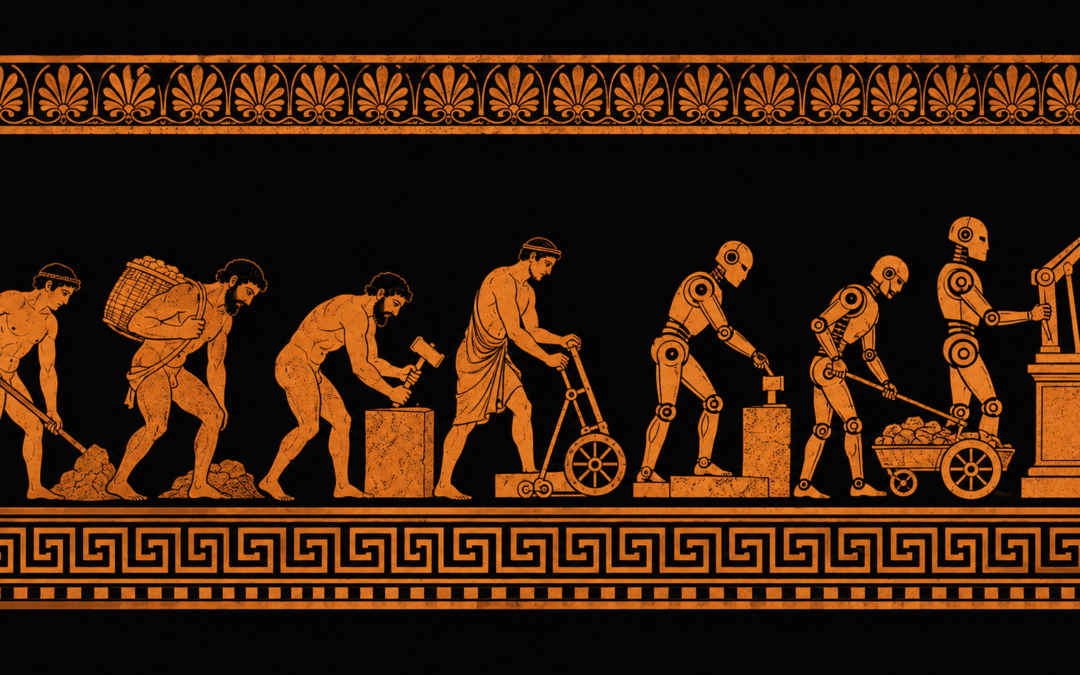
In Talking to My Daughter About the Economy, Yanis Varoufakis asks whether machines really work for us, or whether we increasingly work to serve and maintain them.
Before AI, this question already existed, but the line was easier to see.
Imagine a graphic designer working in a bank. Product, sales and marketing provide the inputs. The designer opens Illustrator and creates the poster. The computer helps, but the designer understands the task, makes creative decisions and produces the final result.
Illustrator is clearly a tool.
Now imagine another person in the same bank, entering customer information into a credit scoring system. The software checks the data, applies rules, calculates a score and may suggest an outcome.
The employee provides the information, but the computer performs an important part of the work.
Even before AI, we could ask: is the employee using the system, or has the employee become an input that the system needs?
AI changes both examples
Today, product, sales and marketing can give their inputs directly to an AI tool.
AI can create several poster options, change the text, try different styles and prepare versions for different channels. A person may still select the best option, correct mistakes and approve the final result.
But the role has changed.
The designer may move from creator to editor, from someone who produces the work to someone who gives instructions and checks the output.
The same is happening in financial processes.
AI can read documents, extract customer data, identify missing information, prepare a risk summary and suggest a decision. The analyst may still review the case and formally approve the result.
But when the system produces most of the analysis, while the human provides inputs, checks exceptions and keeps the responsibility, who is the tool?
“Tools for work”
In ancient Greece, some citizens had time for politics, philosophy and art because other people performed most of the hard work.
Those “tools for work” were often people. Slaves and others without the same rights created freedom for a small part of society.
Today, for the first time, the tools could really be tools.
Machines, software, robots and AI could perform much of the work that people currently do. In theory, this could give people more time, more security and more freedom.
This is the optimistic direction, something close to Star Trek. Technology creates abundance, basic needs are covered and people are not forced to sell most of their time simply to survive.
But there is also another direction.
The main question is who will benefit when machines perform more of the work.
Market-led economies may try to keep AI and robots primarily as privately owned capital.
State-led systems may try to direct more of their value through public priorities.
Europe may once again look for a model that keeps private innovation, but redistributes some of the gains and limits some of the risks.
The final outcome will probably be a mix.
But the ownership question will remain.
If machines can eventually perform much of the work, will everyone enjoy the results, or only the owners of the tools?
So, who was the tool here?
I used AI to help create this article.
It helped me organise the structure, test some arguments and improve the English. But I chose the topic.
So, who was the tool?